

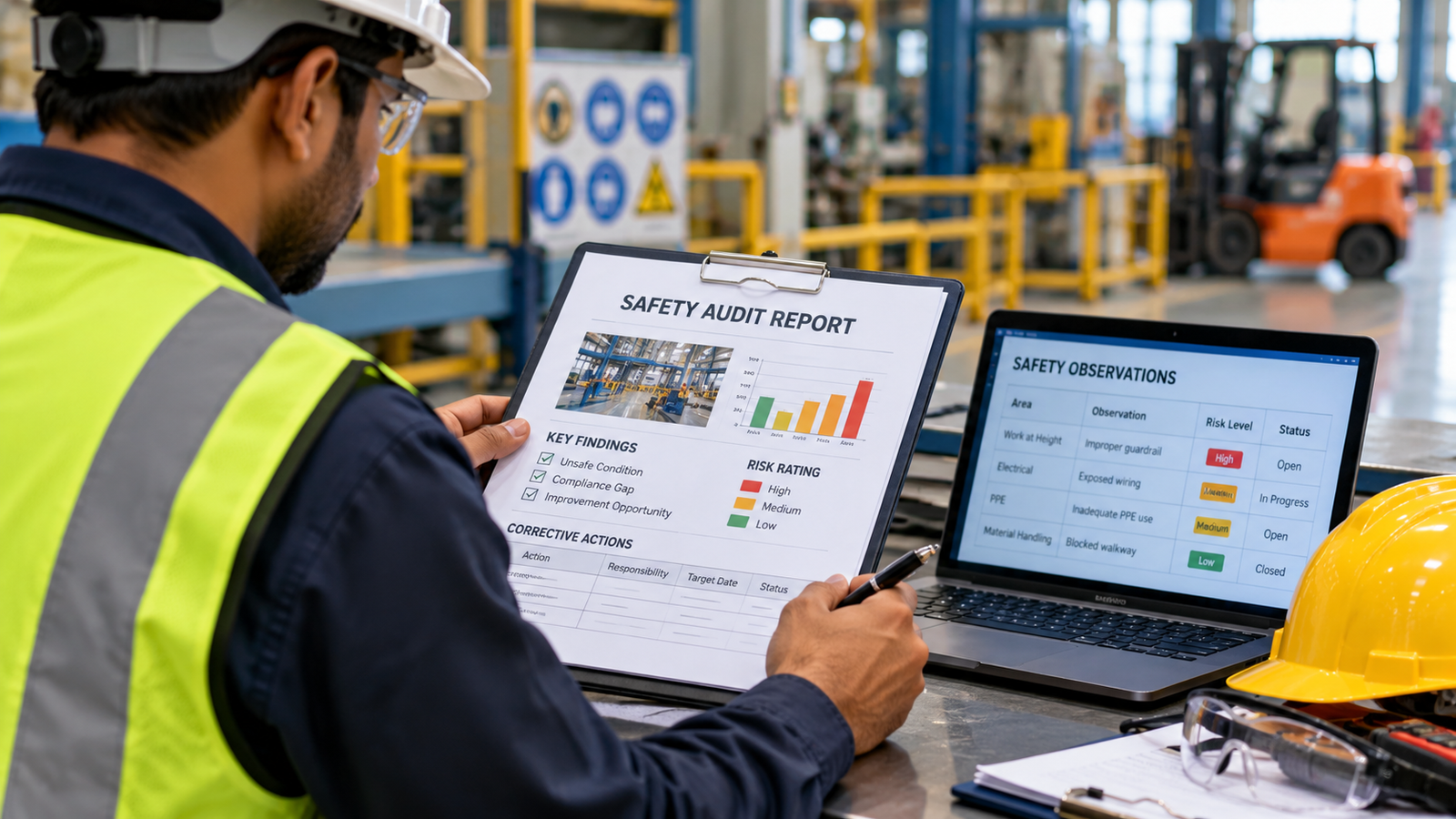
A safety audit does not end when the inspection is complete. Organizations need to document the findings clearly so teams can understand identified gaps, assign corrective actions, and track improvements. A safety audit report provides a structured record of what the audit team assessed, what they observed, and what actions the organization may need to take.
A well-prepared safety audit report helps organizations review workplace safety conditions, prioritize areas that need attention, and follow up on corrective actions. It can also provide useful documentation for ongoing safety management and compliance activities.
However, the format of a safety audit report can vary depending on the audit scope, workplace, processes, and organizational requirements. Most effective reports still contain several key elements that make findings clear and actionable.
In this guide, we explain what a safety audit report is, what it contains, how teams prepare it, and how organizations can use it to support workplace safety improvements.
What Is a Safety Audit Report?
A safety audit report is a structured document that records the findings from a workplace safety audit. It explains the areas assessed, observations made during the audit, identified safety gaps, and recommended corrective actions.
The report turns audit observations into documented information that teams can review and act upon.
Depending on the audit scope, a safety audit report may cover areas such as:
- Personal protective equipment (PPE)
- Electrical safety
- Fire safety
- Work at height and fall protection
- Machinery and equipment safety
- Warehouse and rack safety
- Lockout/Tagout (LOTO)
- Confined spaces
- Chemical safety
- Permit-to-work systems
- Material handling and vehicle safety
The report should present findings in a clear and organized manner so that responsible teams can understand the issue, determine the required action, and track its status.
Why Is a Safety Audit Report Important?
A safety audit identifies conditions, practices, or processes that may require attention. The safety audit report then documents those findings and gives the organization a clear basis for follow-up.
As a result, a well-structured report can help organizations:
- Document safety observations and findings
- Identify gaps in existing safety controls
- Prioritize corrective actions
- Assign responsibility for addressing findings
- Track corrective action progress
- Maintain an organized record of the audit
- Support continuous workplace safety improvement
The report is therefore more than a record of an inspection. It can become a practical reference for managing safety improvements after the audit has been completed.
What Does a Safety Audit Report Include?
There is no single format that applies to every safety audit report. The contents depend on the audit scope, workplace, processes assessed, and applicable organizational requirements.
However, a comprehensive report commonly includes the following sections.
1. Audit Details
The report normally begins with basic information about the audit, such as:
- Date of the audit
- Location
- Department or area assessed
- Audit team or auditor
- Audit reference number, where applicable
- Type of audit
- Scope of the assessment
These details establish the context of the report and make it easier to identify the audit later.
2. Scope and Areas Covered
The report should explain what was included in the assessment.
For example, an audit may focus on a particular production area, warehouse, electrical installation, work-at-height activity, or safety management process.
Clearly defining the scope helps readers understand what was assessed and what was outside the audit.
3. Safety Observations
The report records observations made during the audit.
These may include conditions observed at the workplace, practices followed by employees, equipment conditions, documentation gaps, or weaknesses in existing safety controls.
Where appropriate, observations can be supported with photographs or other evidence.
4. Identified Safety Gaps
The report should clearly describe the safety gaps identified during the assessment.
A useful finding should explain:
- What was observed
- Where it was observed
- Why it requires attention
- Which safety control may need improvement
Clear descriptions make it easier for responsible teams to understand and address the finding.
5. Risk and Priority
Depending on the audit methodology used, findings may be assigned a level of priority or risk.
This helps organizations determine which findings require more immediate attention and which can be addressed through planned corrective actions.
The classification system should be based on the organization’s audit methodology or applicable requirements rather than assuming that one classification system applies to every audit.
6. Corrective Actions
A safety audit report should provide practical recommendations for addressing identified gaps.
Corrective actions may include improvements to:
- Procedures
- Equipment
- PPE
- Training
- Engineering controls
- Safety signage
- Inspection systems
- Work practices
- Documentation
The recommended action should be sufficiently clear for the responsible team to understand what needs to be addressed.
7. Responsibility and Target Dates
Where corrective actions are assigned, the report can identify the responsible department or person and the expected completion date.
This creates accountability and makes follow-up easier.
8. Closure Status
A report may also include the current status of corrective actions.
For example:
- Open
- In progress
- Closed
- Pending verification
Tracking closure helps organizations determine whether identified findings have actually been addressed.
9. Supporting Evidence
Photographs, inspection records, documents, measurements, checklists, or other relevant evidence can support findings in the report.
Supporting evidence can make observations easier to understand and can provide a useful reference during corrective-action follow-up.
How Is a Safety Audit Report Prepared?
Teams generally prepare a safety audit report after completing the assessment and reviewing the observations collected during the process. The report should present the findings clearly so that the organization can understand the identified gaps and determine appropriate actions.
A typical process includes the following steps:
1. Audit Planning
The audit scope, objectives, areas to be assessed, and relevant safety requirements are established before the assessment begins.
2. Workplace Assessment
The audit team reviews the selected workplace areas, processes, equipment, procedures, and safety practices within the defined scope.
3. Recording Observations
Relevant observations and identified gaps are documented during the assessment. Photographs, records, checklists, or other supporting evidence may also be collected where appropriate.
4. Reviewing Findings
The observations are reviewed and organized so that significant safety gaps and areas requiring corrective action are clearly identified.
5. Recommending Corrective Actions
Recommendations are developed for addressing the identified findings. The actions should be practical and relevant to the specific workplace or process assessed.
6. Preparing the Report
The findings, observations, recommendations, supporting evidence, and other relevant audit information are compiled into the safety audit report.
7. Corrective Action and Closure
After the report is issued, responsible teams can implement corrective actions and provide evidence of completion. Findings can then be reviewed to determine their closure status.
What Are Common Findings in a Safety Audit Report?
The findings recorded in a safety audit report depend on the workplace, audit scope, and activities being assessed. Common areas of observation can include:
- Inadequate or incorrect use of PPE
- Unsafe work-at-height practices
- Electrical safety gaps
- Incomplete LOTO practices
- Machine safety concerns
- Warehouse and rack safety issues
- Confined-space control gaps
- Fire safety deficiencies
- Chemical safety concerns
- Permit-to-work system gaps
- Forklift and vehicle safety concerns
These findings should be described clearly and linked to the relevant area, process, or safety control so that corrective actions can be planned effectively.
How Are Safety Audit Findings Prioritized?
Different audit findings may require different levels of attention. Organizations can prioritize findings based on factors such as potential risk, severity, existing controls, exposure, and applicable requirements. As a result, a clear priority system helps management and responsible teams determine where corrective action should focus first.
The prioritization approach can vary depending on the organization’s audit methodology and the type of assessment being conducted.
A clear priority system helps management and responsible teams determine where corrective action should be focused first.
What Is a Corrective Action Plan?
A corrective action plan turns identified audit findings into specific actions that teams can assign, implement, and follow up.
In practice, the process can follow this sequence:
Finding → Recommended Action → Responsibility → Target Date → Evidence → Verification → Closure
This approach makes the audit process more useful because teams can follow findings through to closure instead of simply recording them in a report.
What Happens After a Safety Audit Report Is Issued?
Issuing a safety audit report does not end the safety improvement process. Teams should review the findings, assign corrective actions, and track each action through to closure.
A typical follow-up process may include:
- Reviewing the audit findings
- Assigning corrective actions
- Implementing the required improvements
- Collecting supporting evidence
- Verifying completed actions
- Updating the closure status
Follow-up is important because documenting a finding alone does not address the underlying safety gap. Effective closure requires the recommended action to be implemented and appropriately verified.
Safety Audit Report vs Safety Audit
Although the terms are closely related, a safety audit and a safety audit report refer to different parts of the process.
| Safety Audit | Safety Audit Report |
|---|---|
| The assessment or review process | The documented outcome of the assessment |
| Examines workplace conditions, processes and controls | Records observations, findings and recommendations |
| Involves inspection, review and evaluation | Provides a structured record for follow-up |
| Identifies areas requiring attention | Helps track corrective actions and closure |
In simple terms, the safety audit is the assessment, while the safety audit report documents what was found and what may need to happen next.
How ViDe Turnkey Solutions Supports Safety Audits
Safety audits can cover different workplace activities and risk areas depending on the organization’s requirements. ViDe Turnkey Solutions provides Safety Audit & Closure Services across several areas, including laboratory safety, work at height and fall protection, HIRA studies, chemical safety, process safety, construction safety, permit-to-work, confined space, LOTO, PPE, forklift and vehicle, warehouse, rack, and machine safety audits.
These services can help organizations identify workplace safety gaps, document findings, and work toward corrective action and closure.
ViDe also provides related electrical protection and fire protection services, including electrical safety audits, fire systems audits, fire protection and adequacy reports, and other workplace safety solutions.
Conclusion
A safety audit report provides a structured record of what was assessed, what was observed, and which areas may require corrective action. When findings are clearly documented and followed through to closure, the report can become a practical tool for improving workplace safety.
The format and level of detail can vary depending on the audit scope, workplace, processes, and organizational requirements. What matters is that the report clearly communicates the findings and provides a useful basis for corrective action and follow-up.
For organizations conducting workplace safety assessments, a well-prepared report can help turn audit observations into measurable safety improvements.
Need support with a workplace safety audit?
ViDe Turnkey Solutions provides safety audit and closure services covering multiple workplace safety areas, from HIRA and PPE audits to warehouse, electrical, LOTO, machine, and work-at-height safety assessments.
Explore our Safety Audit & Compliance Services to learn more.